
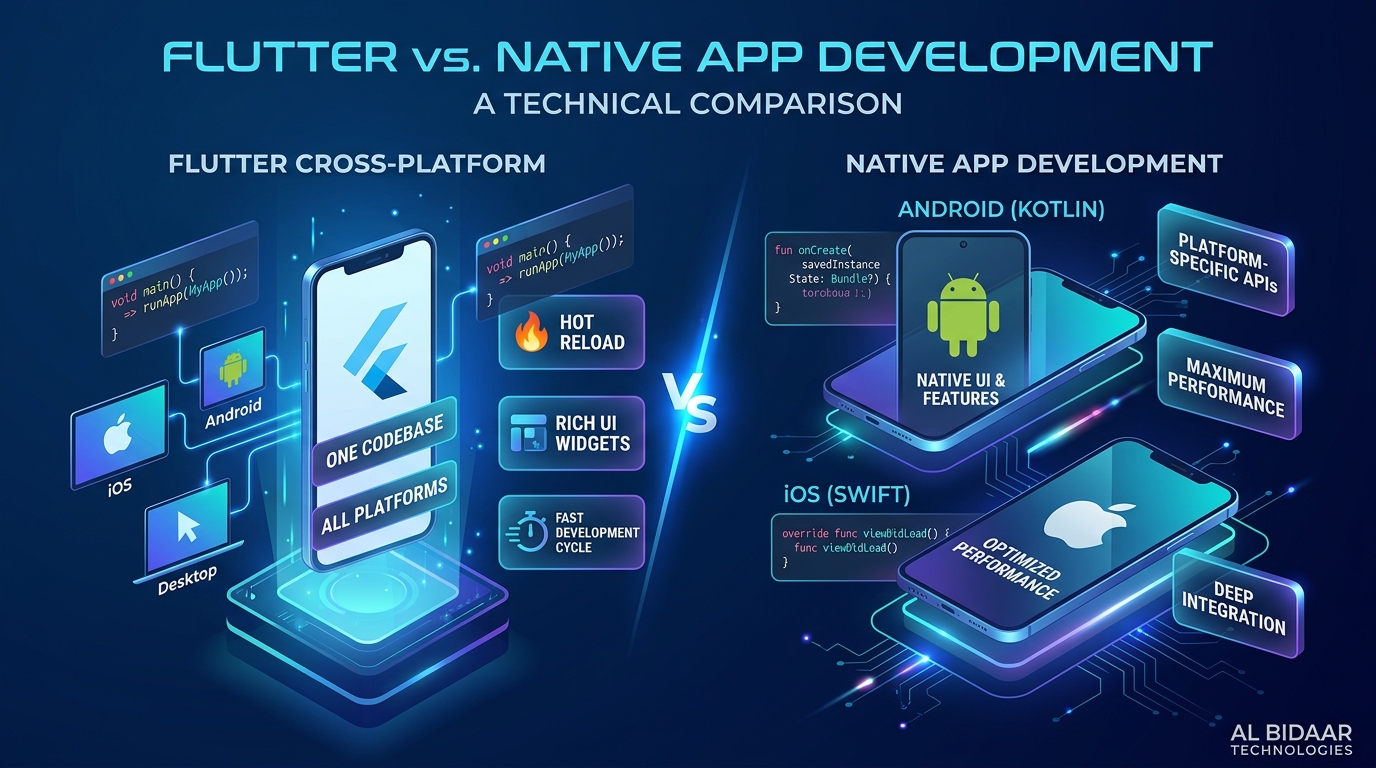
Choosing the right technology for a mobile application is one of the most important decisions a business can make before development begins.
For many companies, the decision comes down to two options: Flutter app development or native app development.
Both can produce high-quality Android and iOS applications, but they differ in development speed, cost, performance, maintenance, platform access, and long-term flexibility.
For Pakistani startups and businesses working with limited budgets, fast launch cycles, and the need to support both Android and iOS users, the choice can have a major impact on the project's total cost and future growth.
This guide compares Flutter and native app development from a practical business perspective.
What Is Flutter?
Flutter is a cross-platform application development framework created by Google that allows developers to build apps for multiple platforms from a shared codebase.
Instead of writing completely separate applications for Android and iOS, developers can reuse much of the same application logic and interface code.
This can reduce development time, duplicated work, maintenance effort, and time to market.
Flutter is commonly used for startup apps, ecommerce applications, booking platforms, business applications, dashboards, service marketplaces, customer portals, and internal business tools.
For many projects, Flutter provides a strong balance between development speed and user experience.
What Is Native App Development?
Native app development means building an application specifically for one operating system.
For example:
- Android apps may be developed using Kotlin or Java
- iOS apps may be developed using Swift or Objective-C
If a company wants separate Android and iOS applications, native development usually means maintaining two codebases.
Native development gives developers direct access to platform-specific features and APIs.
This can be useful for applications that require deep device integration, highly specialized hardware functionality, advanced background processing, platform-specific performance optimization, or complex operating-system integrations.
Flutter vs Native App Development: Quick Comparison
| Factor | Flutter | Native |
|---|---|---|
| Codebase | Mostly shared | Separate Android/iOS codebases |
| Development speed | Usually faster | Usually slower for two platforms |
| Initial cost | Often lower | Often higher |
| Maintenance | Easier across platforms | Separate maintenance |
| Performance | Strong for most business apps | Best for demanding platform-specific use cases |
| UI consistency | High across platforms | Fully platform-specific |
| Device API access | Good, sometimes plugin-dependent | Direct/native access |
| Time to market | Faster in many cases | Longer if both platforms are required |
| Best for | Startups, SMEs, cross-platform products | Highly specialized or performance-sensitive apps |
This is a general comparison. The right choice still depends on the actual project.
1. Development Cost
For many businesses, cost is one of the biggest differences between Flutter and native development. When partnering with a mobile app development company, establishing the optimal technical architecture early helps prevent costly rework.
Flutter
Flutter can often reduce development cost because much of the application is built once and reused across Android and iOS.
This can reduce duplicated work across development, testing, and maintenance.
Native
Native development often requires separate Android and iOS work.
That can increase development hours, QA effort, maintenance costs, and feature synchronization work.
Which Is More Affordable?
For many startups and SMEs, Flutter is usually the more cost-efficient option when both Android and iOS support are required.
But businesses should choose technology based on project requirements rather than selecting Flutter only because it may cost less.
2. Development Speed
Flutter is often faster to develop for cross-platform projects because much of the same code can be reused across Android and iOS.
This can be especially useful for MVPs and businesses that want to reach the market quickly.
Native development can take longer when the same feature has to be developed separately for both platforms.
3. App Performance
Native applications have direct access to platform APIs and can be optimized specifically for Android or iOS.
This makes native development especially suitable for high-performance games, intensive graphics, advanced video processing, AR/VR, specialized Bluetooth or hardware integrations, and complex background services.
Flutter offers strong performance for most typical business applications such as ecommerce apps, booking apps, service platforms, marketplaces, dashboards, business management tools, and customer portals.
For many businesses, users will not notice a meaningful difference in normal app usage.
4. User Interface and Design
Flutter provides strong control over application interfaces and allows developers to create consistent visual experiences across Android and iOS.
Native development allows each platform to follow its own design conventions more closely.
The best approach depends on the product's design goals. Integrating modern UI/UX design standards ensures user retention regardless of framework.
5. Maintenance
With a shared Flutter codebase, many fixes and feature updates can be applied across both Android and iOS together.
Native applications require separate codebases, so a bug or new feature may need separate implementation on each platform.
For businesses with limited technical teams, Flutter can reduce long-term maintenance complexity.
6. Testing
Flutter can simplify testing because much of the application's logic is shared.
However, both Android and iOS versions still require proper device and platform testing.
Test:
- different screen sizes
- Android and iOS versions
- permissions
- push notifications
- payment flows
- camera access
- file handling
- login systems
- network conditions
7. Access to Device Features
Native apps have the strongest direct access to device and operating-system functionality.
Flutter supports many features through packages and native integrations.
For standard business applications, this is usually enough. For highly specialized hardware applications, native development may provide more flexibility.
8. Scalability
Both Flutter and native applications can scale successfully.
Scalability also depends on backend architecture, database design, APIs, hosting, caching, security, application architecture, and code quality.
A poorly designed native app can struggle to scale, while a well-designed Flutter app can support a large and growing user base.
9. Flutter for Pakistani Startups
Flutter can be especially attractive for Pakistani startups that need to control costs, launch quickly, support Android and iOS, validate an idea, release an MVP, and update features rapidly.
It can be suitable for marketplace startups, delivery applications, educational platforms, booking systems, fintech interfaces, healthcare applications, ecommerce apps, and service platforms.
The final technology decision should still depend on product requirements.
10. Native Apps for Enterprise Projects
Native development may be a stronger choice for projects involving deep operating-system integration, specialized security requirements, complex device integrations, performance-sensitive processing, advanced hardware access, or platform-specific experiences.
Large organizations may also have dedicated Android and iOS teams, making separate codebases easier to manage when building enterprise platforms or custom software development systems.
11. Which Is Better for Android Development?
If an application will only ever be developed for Android, native Android development can be a strong choice.
However, if iOS may be added later, Flutter can make future cross-platform expansion easier.
12. Which Is Better for iOS Development?
For applications built exclusively for Apple devices, native iOS development can provide the deepest integration with the Apple ecosystem.
If the project needs both Android and iOS, Flutter can reduce duplicated development effort.
13. Flutter vs Native for MVP Development
For MVPs, Flutter is often a practical choice because a startup can test market demand, user experience, business model, pricing, and product features across Android and iOS without building two completely separate applications.
14. Flutter vs Native for Ecommerce Apps
Flutter works well for many ecommerce applications.
Typical features such as user accounts, products, categories, search, filters, shopping cart, checkout, order history, notifications, and promotions generally do not require highly specialized native functionality.
15. Flutter vs Native for Business Applications
Many business apps include staff dashboards, CRM functionality, inventory management, booking systems, customer portals, reporting, task management, and field-service tools.
Flutter is often a strong option because the business logic can be shared across platforms.
16. Maintenance Cost Over Time
Businesses should consider total ownership cost rather than only initial development cost.
Apps may need years of updates, bug fixes, security improvements, new features, and operating-system compatibility updates.
A shared Flutter codebase can reduce duplicated maintenance work.
17. When Should You Choose Flutter?
Flutter may be a good choice when:
- you need Android and iOS
- budget efficiency matters
- you want a faster launch
- the app is a business or consumer application
- you are building an MVP
- you want easier cross-platform maintenance
- you want consistent branding across platforms
18. When Should You Choose Native?
Native development may be better when:
- performance is extremely sensitive
- the app requires complex device integration
- advanced platform APIs are essential
- the product is designed specifically for one platform
- you have separate Android and iOS teams
- the application relies heavily on operating-system-specific features
19. Flutter vs Native: Which Is Better for Pakistani Businesses?
For many Pakistani startups, SMEs, ecommerce companies, and service businesses, Flutter is often the more practical starting point.
It can provide faster development, lower duplicated effort, Android and iOS support, easier maintenance, and strong user experiences.
Native development becomes particularly valuable when the product has highly specialized performance or device requirements.
The correct decision should come from the product specification, not from choosing a technology only because it is popular.
20. How Much Does Mobile App Development Cost in Pakistan?
Mobile app pricing varies widely.
Cost depends on:
- number of screens
- UI/UX complexity
- backend requirements
- Android/iOS support
- third-party integrations
- payment systems
- notifications
- dashboards
- user roles
- testing
- maintenance
A simple MVP can cost much less than a large ecommerce, logistics, fintech, or enterprise application.
Avoid presenting one universal price for every app.
The best approach is to prepare a requirements document and request a quotation based on the actual scope.
21. Questions to Ask Before Choosing Flutter or Native
Before deciding, ask:
- Do we need Android, iOS, or both?
- What is our available development budget?
- How quickly do we need to launch?
- Does the app require specialized device functionality?
- Will the app need frequent updates?
- How large is our development team?
- What level of performance is required?
- Will we expand to additional platforms later?
- What integrations are required?
- What is the expected maintenance period?
Flutter vs Native: Final Recommendation
There is no universal winner.
Choose Flutter when you want to build Android and iOS applications efficiently with a shared development approach.
Choose native development when your product requires deep platform integration, maximum platform-specific control, or highly specialized performance.
For many Pakistani businesses, Flutter can offer an excellent balance of cost, development speed, user experience, and long-term maintenance.
The best decision should always be based on the actual product requirements.
Mobile App Development with Al Bidaar Technologies
Al Bidaar Technologies develops mobile applications for startups, businesses, and organizations in Pakistan and international markets.
Our mobile development work can include:
- Flutter applications
- Android development
- iOS development
- business applications
- ecommerce apps
- custom mobile platforms
- API integration
- backend development
- UI/UX design
Custom Mobile Solutions
Explore our Mobile App Development Services or contact Al Bidaar Technologies to discuss the right technology for your application.
Frequently Asked Questions
Is Flutter better than native app development?
Flutter is often better for businesses that need both Android and iOS while controlling development time and cost. Native development can be better for highly specialized or platform-specific applications.
Is Flutter good for business apps?
Yes. Flutter is suitable for many business applications including ecommerce apps, booking systems, dashboards, marketplaces, customer portals, and internal business tools.
Is Flutter cheaper than native development?
When both Android and iOS versions are required, Flutter can often reduce duplicated development effort and therefore lower total development cost. Actual pricing still depends on project complexity.
Is native app development faster than Flutter?
For a single platform, native development can be efficient. For both Android and iOS, Flutter can often reduce total development time because much of the code is shared.
Can Flutter handle large applications?
Yes. Flutter can support large applications when the architecture, backend, state management, testing, and development practices are properly designed.
Which is better for a Pakistani startup?
For many Pakistani startups that need Android and iOS with a limited budget and faster launch, Flutter is often a practical choice. The decision should still be based on product requirements.